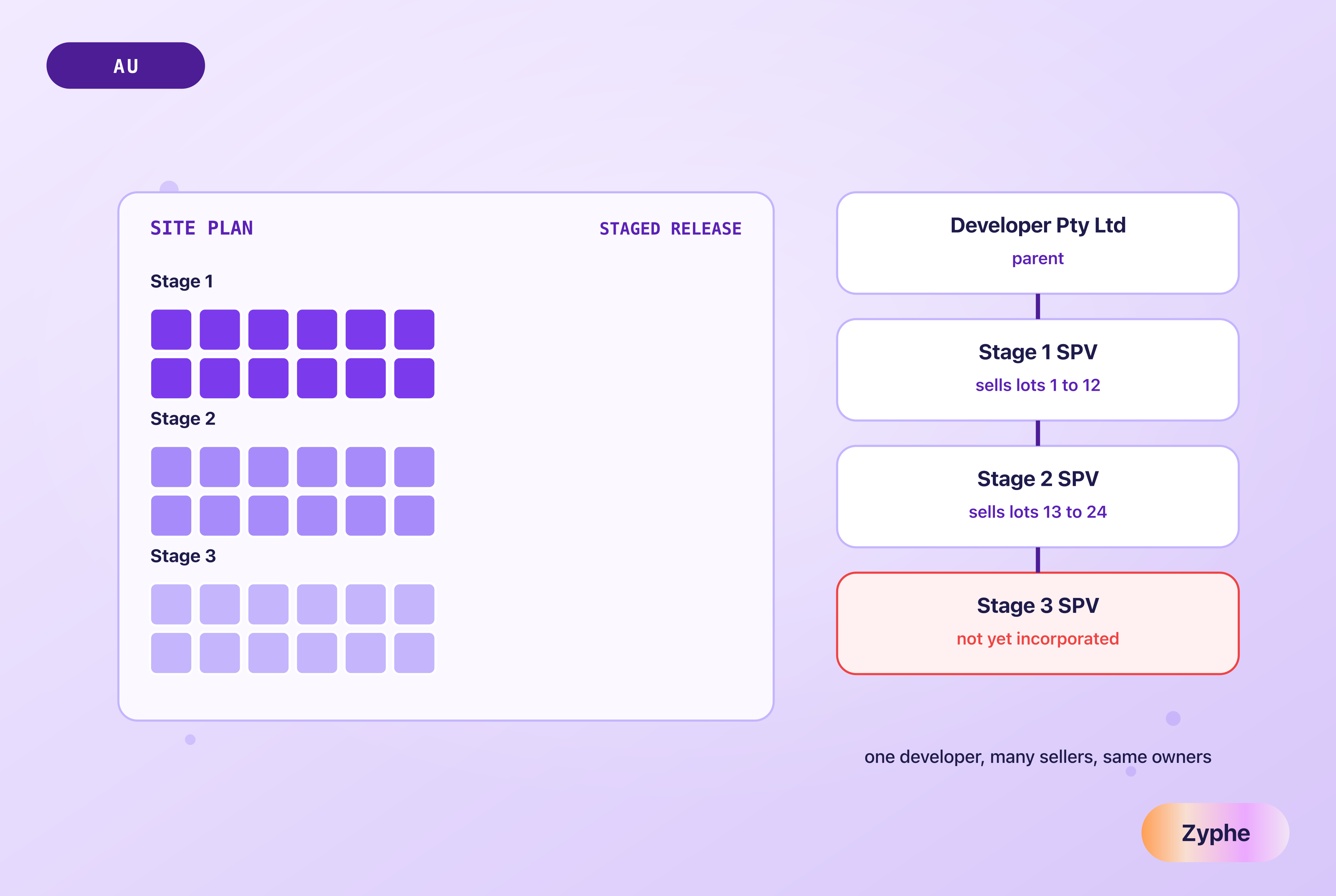
How Australia's AML/CTF Act applies to a developer selling through an SPV in staged releases: the reporting entity, the SPV's owners, bulk purchaser CDD.
Table of contents
- Since 1 July 2026 a property developer that sells house and land packages, off-the-plan apartments or subdivision lots directly, without engaging an independent agent, provides a designated service under table 5 of the AML/CTF Act and is a reporting entity in its own right, according to AUSTRAC's real estate guidance.
- Most developments are sold through a special purpose vehicle: a company formed for one project, owned by the developer group and sometimes by outside investors and financiers, and wound up when the last lot settles. Every reporting entity in the chain, the developer, the selling agent, the conveyancer and the financier, has to verify that SPV and its beneficial owners, and the customer definition for the real estate service is both the seller and the buyer.
- A staged release multiplies the work. Each stage may sit in its own SPV, each purchaser is a new customer whose initial customer due diligence must be complete before the service starts, and settlement risk concentrates at the end of the stage.
- Beneficial ownership of the SPV follows the same test as any company: individuals owning 25 percent or more, directly or through the group, or otherwise controlling it. A developer group with a holding company, a project trust and a mezzanine financier produces a layered chain that has to be followed to individuals.
- Enhanced customer due diligence is mandatory where a purchaser or an owner of the SPV is a foreign politically exposed person or sits in a FATF call-for-action jurisdiction, and source of funds becomes central for high-value off-the-plan purchases.
- The workflow nobody in the Australian market has shipped is bulk onboarding of purchasers across staged releases with the SPV verified once and re-verified on change. That is a KYB and KYC problem, and this guide sets out how to run it.
A special purpose vehicle in property development is a company or trust created to own, develop and sell a single project, insulating the parent group from its liabilities and giving financiers a ring-fenced asset. Under Australia's AML/CTF Act the special purpose vehicle is verified like any company: its registration, directors and the individuals who ultimately own or control it.
TL;DR
A property developer selling directly is a reporting entity under table 5 of the AML/CTF Act; its selling agent, conveyancer and financier are reporting entities under their own tables. Each has to verify the SPV that holds the project, follow its ownership through the developer group to individuals, verify every purchaser before the service starts, apply enhanced customer due diligence where a foreign PEP or a listed jurisdiction appears, and keep the record for seven years. Done stage by stage with spreadsheets it does not scale; done as bulk onboarding against an SPV verified once, it does.
Who is the reporting entity when a developer sells through an SPV?
Australia's Anti-Money Laundering and Counter-Terrorism Financing Act 2006 regulates designated services, not industries, and the 2024 Amendment Act brought real estate into scope from 1 July 2026. AUSTRAC's real estate designated services guidance names two groups likely to provide the table 5 service of brokering the sale, purchase or transfer of real estate: buyer's and seller's agents, and property developers or other businesses selling house and land packages, apartments off the plan and blocks of land in new subdivisions who do not engage independent real estate agents to broker their sales.
So a development sold through an in-house sales team is a designated service provided by the developer, and the developer must enrol with AUSTRAC within 28 days of starting, adopt an AML/CTF programme and run customer due diligence on every purchaser. A development sold through an external agency shifts the table 5 service to the agent, but the developer's own conveyancer or lawyer provides a table 6 professional service when they plan or execute the sale, and the SPV itself is a customer of the financier that lends to it and of the professional firm that formed it. The tranche 2 overview covers the regime; this guide follows the special purpose vehicle through it.
What is a special purpose vehicle, and why do developers use one per stage?
A special purpose vehicle is a company, or sometimes a unit trust with a corporate trustee, created to hold one project. The developer group owns it through a holding company; outside equity investors may own a minority; the construction financier takes security over its assets and often a share of profit. When the last lot settles the SPV distributes the proceeds and is deregistered. Financiers insist on the structure because it ring-fences the project, and developers use it because each project's liabilities stay inside its own company.
Staged releases add a dimension. A subdivision of 120 lots is released in three or four stages, each with its own pricing, its own sales campaign and often its own SPV, so that a stalled stage does not drag down a settled one. From an AML/CTF perspective the effect is that the seller changes from stage to stage while the people behind it stay the same, and a reporting entity that treats each SPV as a fresh, unknown company either repeats the ownership work every time or, worse, stops at the company name.
How do you verify the SPV and its beneficial owners?
A special purpose vehicle is a body corporate, so the customer due diligence rules for bodies corporate apply. Under AUSTRAC's overview of initial customer due diligence the reporting entity must establish on reasonable grounds the identity of the company, of any person acting on its behalf and their authority, of its beneficial owners, whether any of them is a politically exposed person or designated for sanctions, and the nature and purpose of the relationship.
A beneficial owner is an individual who directly or indirectly owns 25 percent or more of the customer or otherwise controls it. AUSTRAC's example of a chain of companies applies exactly: if the owner of the SPV is not an individual, keep following the chain until the individuals are reached. In a typical development structure that means:
| Layer | What sits there | What to establish |
|---|---|---|
| The special purpose vehicle | Project Pty Ltd, or a project unit trust with a corporate trustee | ASIC extract: status, directors, shareholders; for a trust, the deed and the corporate trustee's own owners |
| The developer's holding company | Owns 60 to 100 percent of the project company | Its shareholders, followed upward until individuals appear |
| Outside investors | A syndicate, a family trust, a foreign investor | Each investor holding 25 percent or more of the project company, directly or through the chain, is a beneficial owner |
| The financier | Security over the asset, sometimes a profit share or step-in rights | Rights that amount to control are control, and the controlling individuals are beneficial owners |
| Directors and authorised signatories | The people who sign contracts of sale | Persons acting on behalf of the customer, with authority to act |
The evidence is register data and constitutional documents, not the developer's own organisation chart. Indirect holdings multiply along each link, so a family trust holding 50 percent of a holding company that owns 60 percent of the SPV holds 30 percent and its controllers are beneficial owners. Where a foreign investor sits behind a company in a jurisdiction with a closed register, the branch is recorded as established from certified documents rather than a public source, and its risk is rated accordingly. Our companion guide on beneficial ownership through multi-layer trusts with offshore owners works a structure like this step by step, and what a KYB check involves covers the general method.
Verify the special purpose vehicle once, at the start of the stage, and re-verify on change: a new investor, a change of director, a refinancing. A structure that is checked at stage one and assumed at stage three is the gap a supervisor will find.
Who is the customer of the real estate designated service?
Table 5 is unusual in that the customer is both sides. AUSTRAC's guidance states that when an agent brokers a sale, the customer is both the seller or transferor and the buyer or transferee, so the reporting entity has obligations to both. For a developer selling its own stock, the seller is the developer's special purpose vehicle and the buyers are the purchasers; for an external agent, the SPV is a customer as seller and each purchaser is a customer as buyer.
The guidance also fixes when the service starts. A seller's agent starts providing the service to the seller when the agency agreement is signed, and to the buyer when it is reasonably expected the transaction will proceed, typically when the offer is accepted and the contract is signed. At auction, where the buyer is only known after the hammer falls, initial CDD can be delayed where completing it would disrupt the ordinary course of business, but it still has to be completed. For an off-the-plan release with a launch day and a queue, the practical answer is to verify purchasers as they reserve rather than as they settle, because the service has started long before settlement.
How does initial customer due diligence work across a staged release?
Each purchaser is an individual customer, or a company or trust customer, whose identity must be established before the service starts: name, date of birth and address verified against reliable and independent data, with a government identity document and a liveness check the standard route, and a digital identity service acceptable where its data is independent and reliable. A purchaser buying through a company or a family trust brings the beneficial ownership work with them. Nature and purpose is usually evident from the transaction, but AUSTRAC expects the reporting entity to notice when it is not: a first-time buyer purchasing six lots, or a purchaser whose stated occupation does not fit the price.
Three things change when the release is staged.
- Volume arrives in waves. A launch weekend can produce fifty reservations. Initial CDD has to be complete for each before the service starts, which means the verification flow has to run in parallel, not through a conveyancer's inbox.
- The seller changes, the people do not. If stage two sits in a new SPV, the reporting entity re-establishes the seller, but the beneficial owners and signatories are usually the same individuals already verified for stage one. A workflow that links identities across entities avoids re-verifying the same directors three times.
- Settlement is where the risk lands. Off-the-plan contracts settle months or years after exchange. Ongoing customer due diligence means the purchaser verified at reservation is re-screened before settlement, the source of the settlement funds is understood, and a change in the purchaser's risk, a sanctions designation or a nominee substituted at the last minute, is caught before title transfers.
When is enhanced customer due diligence mandatory on a development?
AUSTRAC's enhanced customer due diligence guidance makes enhanced CDD compulsory where the customer's ML/TF risk is high, where a suspicious matter report must be lodged and the relationship continues, where transactions are unusually large or complex or have no apparent purpose, where the service is part of a nested relationship, where any relevant person is a foreign politically exposed person, and where any relevant person is located or formed in a jurisdiction the FATF has called for enhanced due diligence on.
On a development that produces three recurring cases. A foreign investor in the SPV who is a foreign PEP, or whose holding company sits in a listed jurisdiction, makes enhanced CDD mandatory on the seller side. A purchaser who is a foreign PEP, or a purchaser company formed in a listed jurisdiction, makes it mandatory on the buyer side. And a purchaser buying multiple high-value lots, paying through a third party, or presenting a structure with no obvious rationale, is the unusually large or complex case. AUSTRAC lists the measures: more KYC information, source of funds and source of wealth, the reason for the transaction, closer monitoring, more frequent review, and escalation to senior management, with declining the service explicitly among the options. Our general guide to enhanced due diligence covers the boundary.
What does source of funds look like for off-the-plan purchasers?
Source of funds is mandatory for foreign PEPs and, under enhanced CDD, for the customer where it is relevant to the risk. For property it is also the control that catches the laundering AUSTRAC's National Money Laundering Risk Assessment associates with real estate: the deposit paid by a third party, the settlement funded from an account in another name, the purchaser whose declared income could not have produced the deposit. Evidence is ordinary: bank statements, a sale contract for a previous property, a loan approval, payslips, a gift letter with the giver identified. The point is to ask before settlement, not after, and to record what was seen.
What must be reported and recorded?
Suspicious matter reports are due within 3 business days after the day a suspicion is formed on reasonable grounds, or 24 hours for terrorism financing, under AUSTRAC's SMR guidance, and the duty applies even where the reporting entity declines the sale. A threshold transaction report is due within 10 business days where physical currency of 10,000 dollars or more is involved, which still happens at deposits. Records of how each matter was established are kept for seven years, and AUSTRAC states that copies of identity documents need not be kept, only their details, which for a developer holding hundreds of purchasers' passports is the difference between a compliance file and a breach in waiting.
How does the process run with an agent?
Zyphe's KYB software verifies the special purpose vehicle by purchasing the authoritative ASIC record live and grading the submission against it, then runs ownership discovery through the holding company, the investors and the trustee layers until it reaches natural persons, with stakes multiplied along each chain and the 25 percent test applied to the aggregate. Branches the credit budget cuts stay visible as truncated; a branch that reaches a jurisdiction with no register coverage stays visible as unresolved and is held as a proxy, never reported as a person. Each director and beneficial owner receives a linked KYC flow, and the business verification cannot be approved until it completes; the same individual appearing behind the stage two vehicle is recognised rather than re-onboarded.
Purchasers run through the KYC flow in parallel: document and liveness verification against over 4,000 document versions from 213 countries and territories, sanctions, PEP and adverse media screening, and a risk rating that decides whether enhanced measures apply. Where they do, the UBO and EDD review desk assembles the trace, the screening results and a draft rationale for the reporting entity's own approver. Documents and biometrics are processed transiently and stored encrypted in each individual's own vault; the developer, agent or conveyancer keeps the verification results, logs and proofs, which is the record the Act asks for, without a database of purchasers' identity documents sitting on a sales office server. The data residency position is written down on the security and data handling page.
The bottom line
A development sold through special purpose vehicles and staged releases is the ordinary Australian case, and from 1 July 2026 it sits squarely inside the AML/CTF regime for the developer, the agent, the conveyancer and the financier alike. The obligations are not exotic: verify the special purpose vehicle to its individuals, verify every purchaser before the service starts, escalate the foreign PEP and the listed jurisdiction, understand the settlement funds, report within 3 business days, keep the record for seven years. What makes them hard is volume and repetition, and volume and repetition are what a workflow is for.
This article is general information, not legal advice. Obligations depend on the services a business provides and the structure in front of it, and firms should take advice on their own circumstances.
Related resources
- AUSTRAC tranche 2: enrolment, obligations and deadlines
- Beneficial ownership verification for multi-layer trusts with offshore owners
- AML/CTF for trust and company service providers in Australia
- What is KYB (Know Your Business)?
- Ultimate beneficial owner (UBO)
- Enhanced due diligence: when and how to apply it
- KYB software
- KYC software
- UBO and EDD review desk
Cited sources
- Anti-Money Laundering and Counter-Terrorism Financing Amendment Act 2024 (No. 110, 2024), Federal Register of Legislation
- Anti-Money Laundering and Counter-Terrorism Financing Act 2006, Federal Register of Legislation
- AUSTRAC, Real estate designated services
- AUSTRAC, Overview of initial customer due diligence
- AUSTRAC, Enhanced customer due diligence
- AUSTRAC, Suspicious matter reports
- AUSTRAC, Enrol with us overview
 Michelangelo Frigo (Co-Founder at Zyphe) Michelangelo Frigo is a privacy and identity infrastructure expert and co-founder of Zyphe.