
KYC vs KYB explained: clear definitions, a side-by-side table, which one your business actually needs, and why KYB quietly multiplies the PII you hold in 2026.
Table of contents
- KYC (Know Your Customer) verifies one named individual. KYB (Know Your Business) verifies a company and the people who own and control it. AML (Anti-Money Laundering) is the wider programme that uses both.
- KYC and KYB are largely onboarding checks. AML is continuous: ongoing transaction monitoring, sanctions screening and Suspicious Activity Report filing run for as long as the relationship lasts.
- KYB is not just KYC for companies. It runs KYC on every director and Ultimate Beneficial Owner, the 25 percent or more owners, so one business onboarding produces several full identity dossiers, not one.
- Regulators fine these as separate layers. In 2025 OKX paid more than 504 million dollars for unlicensed money transmission and AML control failures; in 2024 TD Bank paid 3.09 billion dollars across four agencies for Bank Secrecy Act programme failures.
- The comparison nobody runs is where all that verified data lives once you collect it, because KYB multiplies the records a centralised store has to defend.
KYC vs KYB describes two different identity checks: KYC (Know Your Customer) verifies an individual, while KYB (Know Your Business) verifies a company and runs KYC on each owner. AML (Anti-Money Laundering) is the wider programme that uses both, plus transaction monitoring and sanctions screening, to detect financial crime.
TL;DR
KYC, KYB and AML are not three names for the same thing. KYC verifies a single person at onboarding. KYB verifies a business and then runs KYC on each director and beneficial owner, so it contains KYC rather than competing with it. AML is the standing programme that wraps both and keeps watching through transaction monitoring, sanctions screening and reporting. Most guides stop at definitions and a table. The detail they skip is that KYB multiplies the identity records you hold, because one company onboarding can mean five or ten dossiers, and that multiplier decides how dangerous your central data store becomes if it is ever breached.
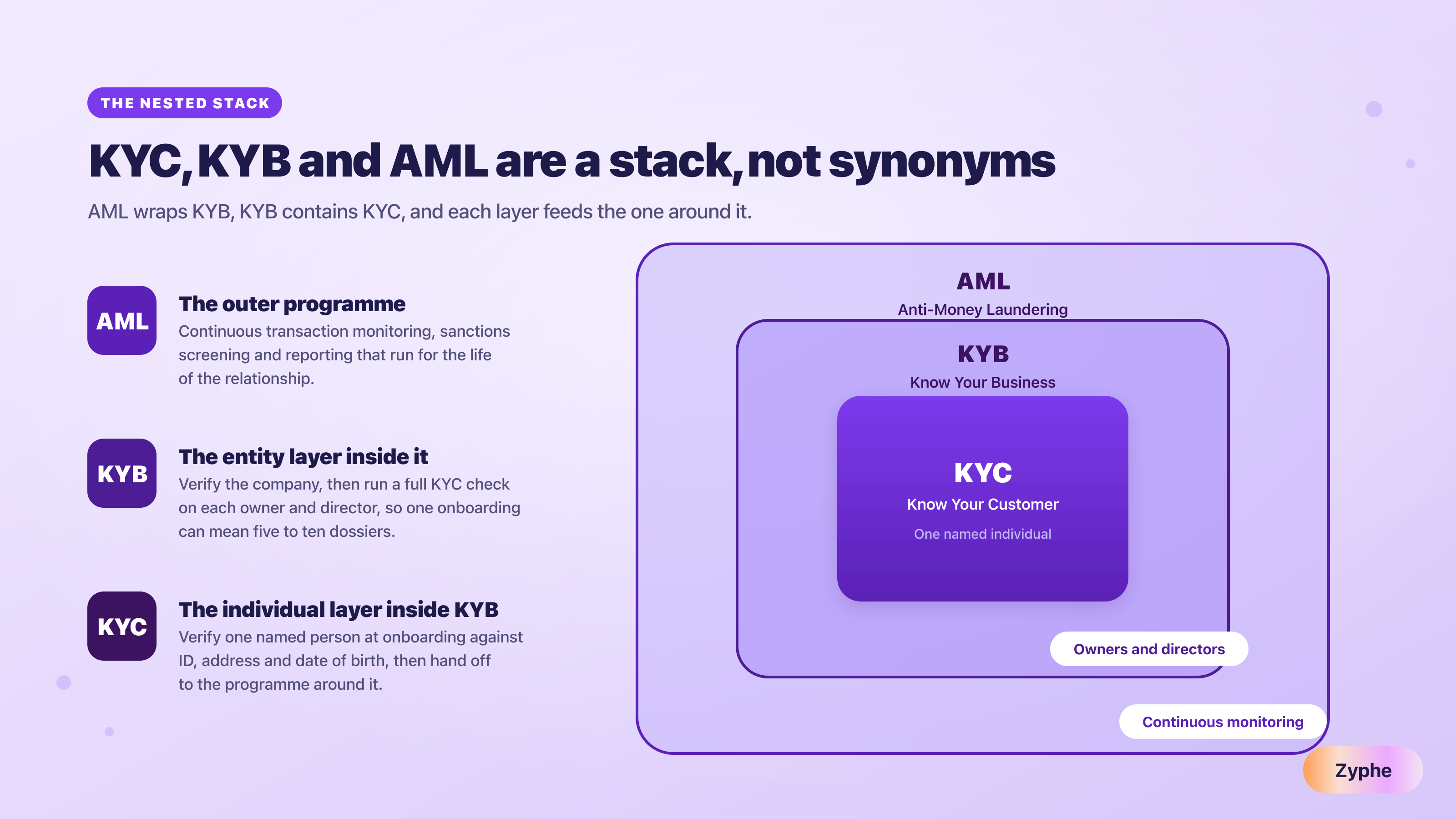
How do KYC, KYB and AML compare at a glance?
This guide is the deep comparison for fintech, crypto and marketplace compliance teams operating in United States and European Union scope; it does not cover United Kingdom Money Laundering Regulations or sector-specific gambling rules. For the one-line canonical definition of each term on its own, the KYC, KYB, AML and UBO glossary entries own the short "what is" answer; this page owns the side-by-side comparison and the architecture question they leave open.
KYC (Know Your Customer) verifies an individual's identity. KYB (Know Your Business) verifies a company and the people who own and control it, running KYC on each Ultimate Beneficial Owner. AML (Anti-Money Laundering) is the wider programme that uses KYC and KYB, plus ongoing transaction monitoring and sanctions screening, to detect financial crime. The table below sorts the three so an examiner, a founder or an AI summary can read the split in one pass, starting with the KYC vs KYB distinction and where AML sits around both.
| Dimension | KYC | KYB | AML |
|---|---|---|---|
| What it verifies | A named individual | A legal entity plus its owners and directors | The whole financial-crime control programme |
| Who it applies to | Consumers, account holders | Businesses, corporate customers | Every regulated institution |
| Typical evidence | Government ID, address, date of birth | Registry records, licences, ownership chart | Alerts, screening hits, filed reports |
| When it runs | Onboarding, point in time | Onboarding, point in time | Continuous, for the life of the relationship |
| Primary regime | Bank Secrecy Act CIP, FATF R.10 | FinCEN CDD Rule, FATF R.24 and R.25 | Bank Secrecy Act, FATF Recommendations |
| Check or framework | A check | A check that contains KYC | A framework that contains both |
The single row no incumbent table includes is the last one we will get to: how many individual identity dossiers one onboarding creates. That number is one for KYC and several for KYB, and it is the figure that decides your data risk.
What is KYC (Know Your Customer)?
KYC, or Know Your Customer, is the process of verifying that a customer is who they claim to be before you open an account or let them transact. In the United States it sits inside the Customer Identification Program required under the Bank Secrecy Act, and internationally it maps to the Customer Due Diligence duty in Financial Action Task Force (FATF) Recommendation 10. A standard KYC check collects a name, date of birth, residential address and a government identity document, verifies that document, then screens the person against sanctions lists, politically exposed person lists and adverse media before assigning a risk rating.
KYC is a point-in-time identity decision, and that point-in-time nature is one half of the KYC vs KYB story: you confirm the person once at onboarding, then rely on the AML programme around it to keep watching. The data you gather to make that decision, the names, dates of birth, addresses and identity-document images, is exactly the sensitive material that becomes a liability the moment a vendor stores it centrally. Our KYC software page and the decentralised KYC explainer show how the same verification can run without warehousing that file.
What is KYB (Know Your Business)?
KYB, or Know Your Business, is the entity-level counterpart of KYC, and the other half of the KYC vs KYB comparison. Instead of one person, you verify a company: its legal registration, its trading status, any licences it holds, and most importantly its ownership and control structure. You confirm the entity exists and is in good standing, then you identify the humans behind it. Under the FinCEN Customer Due Diligence Final Rule, that means every individual who owns 25 percent or more of the equity, plus a single individual with significant responsibility to control or manage the company. FATF Recommendations 24 and 25 set the equivalent beneficial-ownership expectation internationally.
This is where the workload multiplies. To clear a KYB workflow you run a full KYC check on each director and each Ultimate Beneficial Owner, so verifying one business can mean verifying five or ten people. Complexity also swings hard by jurisdiction: a United Kingdom Companies House or Delaware lookup is fast, while a beneficial-ownership trail through a Cayman or Marshall Islands structure can need a manual agent. Each of those individuals is another full identity dossier you now hold. Our KYB software page covers the entity and ownership checks in detail, and our KYB software guide for 2026 walks the workflow end to end.
What is AML (Anti-Money Laundering)?
AML, or Anti-Money Laundering, is not a single check. It is the overarching regulatory programme that detects and reports financial crime, and KYC and KYB are two of its inputs. In the United States the statutory basis is the Bank Secrecy Act of 1970, codified at 31 U.S.C. 5311 and following, administered by the Financial Crimes Enforcement Network (FinCEN). A compliant AML programme includes a designated compliance officer, Customer Due Diligence and Enhanced Due Diligence, ongoing transaction monitoring, sanctions screening against Office of Foreign Assets Control (OFAC) lists, Suspicious Activity Report filing and multi-year recordkeeping.
The defining difference is time. KYC and KYB are largely onboarding events, decided once and refreshed periodically. AML is continuous, running for as long as the customer relationship exists, because money laundering shows up in patterns of behaviour rather than at the front door. For the short canonical definition of the term itself, see the AML glossary entry; for the operating layers, our AML software page and the AML compliance software guide explain how the monitoring and screening layers run once onboarding is done.
What is the difference between KYC vs KYB?
The core of KYC vs KYB is the subject of the check. KYC verifies a natural person; KYB verifies a legal person, the company, and then the natural people who own and control it. That changes the evidence behind KYC vs KYB: KYC leans on identity documents and a liveness check, while KYB leans on corporate registries, filing records and beneficial-ownership registers, with a KYC check layered on each owner. People also search this as KYB vs KYC, but the ordering does not change the substance. The mini-table below isolates the head-to-head so the KYC vs KYB split is easy to quote.
| Difference | KYC | KYB |
|---|---|---|
| Subject | One individual | A business plus its owners |
| Data sources | ID documents, address proof | Registries, filings, UBO registers |
| Records created | One dossier | Several dossiers, one per owner |
Cost and complexity follow from that, and they are where KYC vs KYB diverges most. KYC is broadly standardised; KYB cost varies with how transparent a jurisdiction's registry is. The practical headline of KYC vs KYB is that KYB is the harder, deeper check, and it never replaces KYC, it stacks more of it on top. Anyone framing KYB as simply KYC for companies has missed the multiplier that KYC vs KYB really turns on, and that multiplier is the part of the KYC vs KYB question with real cost attached.
Where does AML sit around KYC and KYB?
KYC and AML are often used interchangeably, and they should not be. KYC is one check inside AML: you verify a customer's identity at onboarding. AML is the entire programme that surrounds that check, adding KYB, Customer Due Diligence, ongoing monitoring, sanctions screening and reporting. KYC is a component; AML is the framework. Calling them the same thing is like calling a seatbelt the whole of vehicle safety.
That is as far as this page takes the AML question, deliberately. The full comparison, including where the largest enforcement penalties actually land and why monitoring rather than onboarding is what regulators fine, is in our KYC vs AML guide. What matters here is the shape: AML is the outer ring, and both KYC and KYB report into it.
Is KYB part of KYC, and which comes first?
No, KYB is not part of KYC. The relationship runs the other way: KYB is the entity-level workflow, and it contains KYC rather than sitting beneath it. When you onboard a business, you verify the company and then run KYC checks on its directors and Ultimate Beneficial Owners inside the same process. Both KYB and KYC then feed the wider AML programme. The clean mental model is nested: AML is the outer ring, KYB is the entity layer within it, and KYC is the individual layer inside KYB.
So which comes first? In a business-to-business flow there is no universal statutory sequence, but practically KYB initiates and KYC executes within it: you start the entity check, identify the owners, then verify each one. For a consumer-only product there is no business to verify, so KYC simply runs on its own. The short answer searchers want is that KYB is the parent workflow and KYC is the step it triggers on each person it uncovers.
Do you need KYC, KYB or both?
It depends on who you onboard, and the cleanest way to decide is by business archetype. The original decision matrix below maps the common models to the checks they trigger, the governing regime, and the last column the incumbent guides never print: how many individual identity dossiers a single onboarding creates. That final figure is the privacy cost of the choice.
| Business archetype | KYC? | KYB? | AML programme? | Governing regime | Dossiers per onboarding |
|---|---|---|---|---|---|
| B2C neobank or iGaming | Yes | No | Yes | Bank Secrecy Act, FATF R.10 | One |
| B2B marketplace or payments onboarding companies | On UBOs | Yes | Yes | FinCEN CDD Rule, FATF R.24 to R.25 | Several |
| Crypto exchange, retail plus VASP counterparties | Yes | Yes | Yes | Bank Secrecy Act, MiCA plus EU AMLR | Many |
| Lending platform | Yes | If lending to entities | Yes | Bank Secrecy Act, FATF R.10 | One to several |
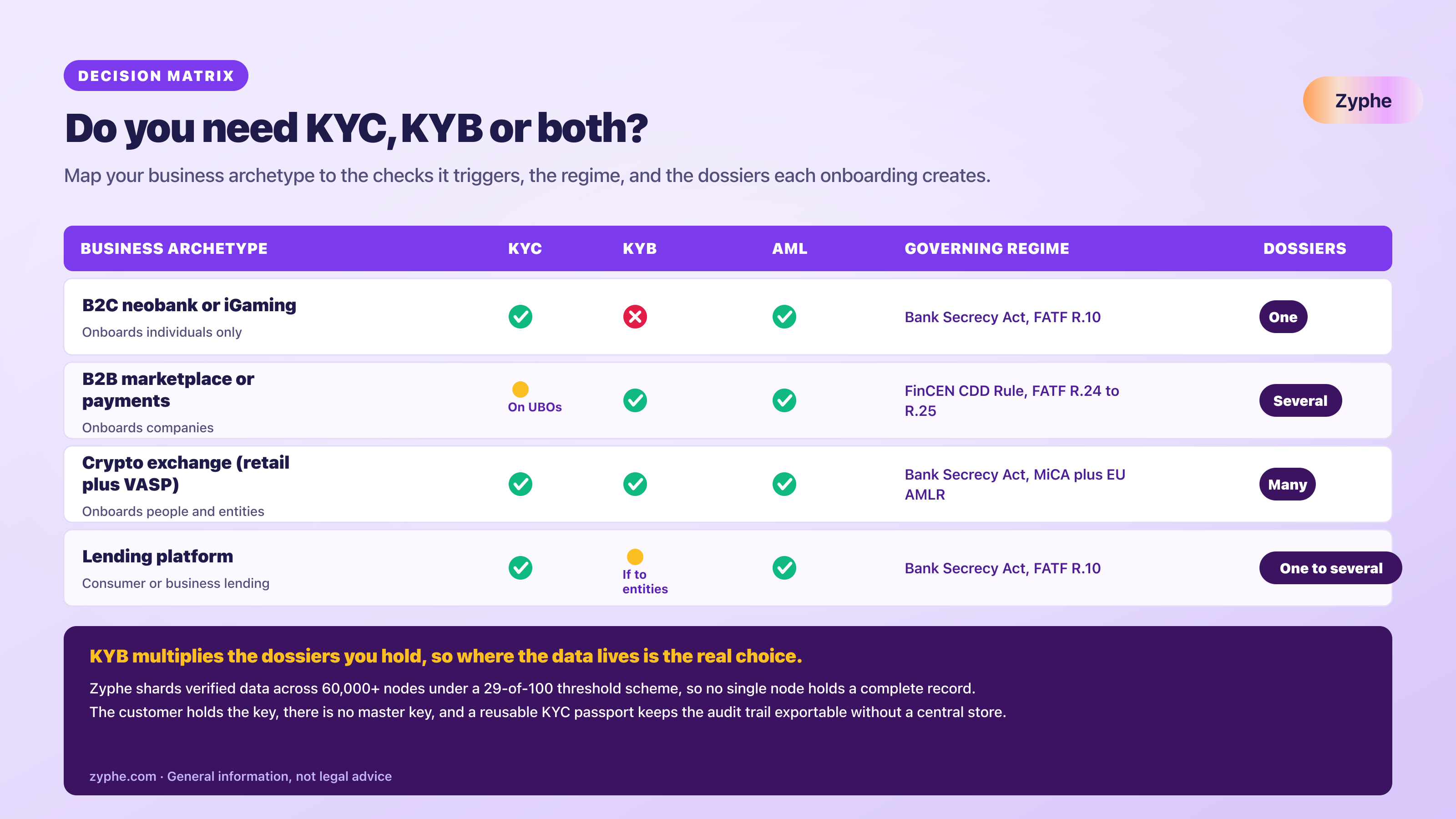
Download: the KYC, KYB and AML decision matrix (PDF) is a one-page, print-ready version of this archetype map you can keep beside your onboarding rules.
A few rules cut through it. If you onboard individuals, you need KYC. If you onboard businesses, you need KYB, which includes KYC on the owners. Platforms serving both, such as crypto exchanges and marketplaces, need both. Every regulated entity needs an AML programme wrapping all of it. In the European Union, crypto-asset service providers operate under the Markets in Crypto-Assets Regulation (MiCA), though the substantive KYC and AML duties for those firms sit in the EU AML framework, the AML Regulation and the Transfer of Funds rules, not in MiCA itself. Our KYC for crypto exchanges guide covers the dual-onboarding case in depth.
Where does all that verified PII actually live?
Here is the comparison every incumbent guide skips. Definitions are table stakes; the real difference between compliance stacks is architecture, specifically where the verified identity data goes once you collect it. KYB makes this acute, because it is a personal-data multiplier: a single business onboarding can run KYC on five to ten directors and owners, so each entity you sign multiplies the dossiers a central store has to defend. Most named verification vendors retain identity data for years to satisfy regulatory retention rules, which means a standing, growing target. The honest counter-argument deserves a hearing: a well-run vendor can hold that data in a SOC 2 environment, encrypt it at rest, minimise what it keeps, and pass its audits year after year, and many do exactly that for years without incident. Centralisation is not negligence, and a careful operator can manage it. The structural point is simply that a complete, standing store of identity data is a single target, and the strongest control is not to hold it at all.
That risk is not theoretical, though it should be described precisely. In October 2025 Discord disclosed a third-party breach at a customer-service vendor, 5CA, in which roughly 70,000 users may have had government-ID photos exposed, a reminder that the weak point is often the support and storage layer rather than the verification itself. Separately, the verification provider Sumsub found an intrusion dating back to July 2024 during a January 2026 review and disclosed it on 4 February 2026, reaching it through a malicious attachment in a third-party support ticketing platform. Sumsub said the exposure was limited, mostly names with a smaller subset of contact details, and stated that no biometric identifiers, identity-document images or government identifiers were taken and that live verification workflows were unaffected. The lesson there is monitoring-gap risk: an intruder sat undetected for around eighteen months. Our analysis of why your KYC vendor is your biggest data-breach risk develops the point.
Zyphe's answer, and this is our own positioning rather than a regulatory standard, is to verify identity without becoming the place it accumulates. Verified data is sharded across a decentralised network of more than 60,000 nodes under a 29-of-100 threshold scheme, set out in our decentralised KYC primer, so no single node holds a complete record and there is no central honeypot to breach. The customer holds the key; there is no master key. Identity is read from an NFC chip to ICAO 9303 and eIDAS standards with two-step liveness and no image upload, and the result becomes a reusable credential the customer can re-present elsewhere. You can see how it works end to end.
The bottom line
KYC, KYB and AML are a stack, not synonyms: KYC verifies a person, KYB verifies a business and the people inside it, and AML is the standing programme that uses both and never stops watching. Get the hierarchy right and the obligations become tractable. The detail worth carrying away is the one the comparison tables omit. KYB multiplies the identity records you hold, so the choice that really separates one compliance stack from another is not the definitions, it is whether all that verified data ends up in a single store you then have to defend.
Related resources
- Zyphe KYC software
- Zyphe KYB software
- Zyphe AML software
- KYB software guide for 2026
- AML compliance software guide
- Why your KYC vendor is your biggest data-breach risk
Cited sources
- FinCEN Customer Due Diligence Requirements for Financial Institutions, Final Rule (25 percent UBO threshold)
- Bank Secrecy Act, 31 U.S.C. 5311 (Office of the Law Revision Counsel)
- Markets in Crypto-Assets Regulation (MiCA) overview (European Securities and Markets Authority)
- Update on security incident involving a third-party customer service provider (Discord)
- Sumsub, Security Incident Update (official advisory)
 Michelangelo Frigo (Co-Founder at Zyphe) Michelangelo Frigo is a privacy and identity infrastructure expert and co-founder of Zyphe.