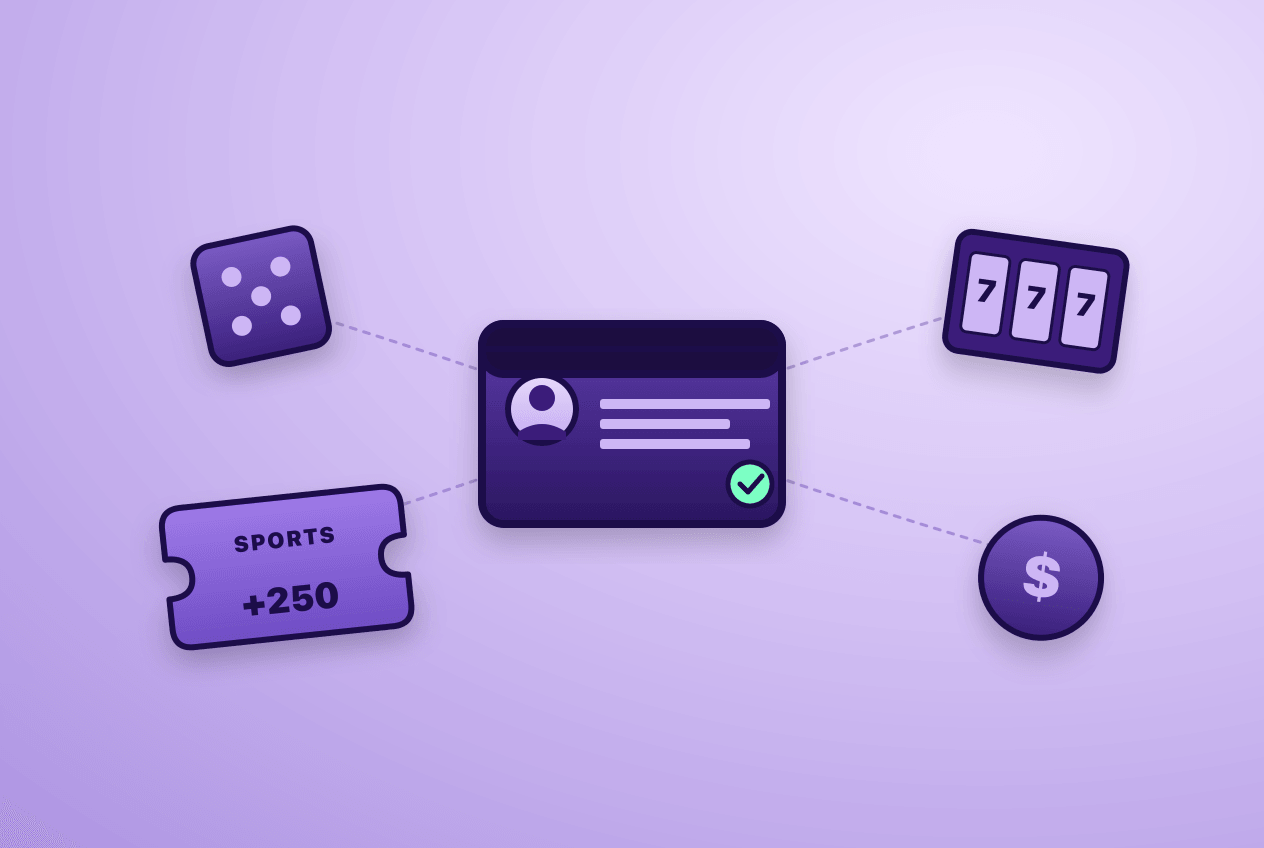
KYC for iGaming is the verified-identity layer a multi-vertical operator runs once across sportsbook, daily fantasy, casino, and lottery on a single player base. It covers age, identity, address, sanctions, source of funds, and geolocation across US multi-state regimes, and runs perpetual monitoring at the credential layer rather than periodic review.
Why is KYC for iGaming uniquely hard in 2026?
Three things make KYC for iGaming harder than any single-vertical fintech or pure online casino. Operators run multiple verticals on one player base. The US side fragments into 27+ jurisdictions with different rules each. And the speed of in-play betting collides with the speed of legacy KYC vendors. The bill is now arriving.
Global casino and iGaming operators paid roughly USD 160 million in regulatory penalties in just the first half of 2025. The UKGC settled with Bet365 for £582,120 over ineffective KYC and customer due diligence. Flutter’s Paddy Power and Betfair were fined £2 million in December 2025 for not identifying problem gamblers fast enough. The DFS world had its enforcement moment too: PrizePicks settled with the New York State Gaming Commission for nearly USD 15M, and Underdog Fantasy settled for USD 17.5M, both for offering contests outside the licensed scope.
For broader regulatory context, see our enhanced due diligence vs standard CDD breakdown and the dedicated KYC for casino page if your operation is casino-only.
What we hear from operators and partners
"Operators pour money into affiliates. Compliance vendors come last."
"Casinos strictly limit data sharing to regulators. The KYC for iGaming stack has to respect that."
"Gambling rankings change multiple times a day. Onboarding is where you lose them."
"Nobody budged on adding a new vendor. Nobody cared."
The pattern is consistent. The compliance team needs a defensible audit. The product team needs the player to convert. The CTO doesn’t want yet another vendor in the data path.
What does KYC for an iGaming platform actually need to cover?
More than a single-vertical fintech, less than a fully regulated bank, and with three checks that get compliance leads fired when they fail: age, self-exclusion, and source of funds. Layer on geolocation for any US sportsbook, ongoing monitoring for problem-gambling triggers, and entity-level KYB for B2B partners on your rail. The table below is the minimum-viable KYC for iGaming stack the major regulators expect.
| Check | Why an iGaming operator needs it | Zyphe coverage |
|---|---|---|
| Age verification | Variable thresholds: 18 in most EU jurisdictions, 21 in some US states, 19 in Nebraska / Alabama for DFS | NFC chip read, ID OCR, and liveness with jurisdiction-specific thresholds |
| Identity (ID and liveness) | UKGC and MGA technical standards, deepfake-resistant under 2025 guidance | Document OCR, NFC, liveness, deepfake detection |
| Address verification | Tax residency, jurisdiction routing, deposit-limit assignment | Document or trusted-source verification |
| Geolocation | US sportsbook licensing requires the player to be physically in-state | GeoComply-compatible, real-time at signup and at wager |
| Sanctions, PEP, adverse media | AML obligation under FATF and local AMLDs | Continuous re-screening, configurable thresholds |
| Source of funds (EDD) | Required for high-deposit and VIP players in nearly every regime | Document upload, automated review, sign-off workflow |
| Self-exclusion | GAMSTOP (UK), Spelpaus (SE), Coalition for Fantasy Sports plus idPair (US DFS), state-specific registries | Integrated registry checks at signup, deposit, and configurable triggers |
| Ongoing monitoring | Continuous CDD, transaction monitoring, problem-gambling triggers | Pair with AML software; see our perpetual KYC breakdown |
For deeper detail, see adverse media screening AML guide and the three pillars of customer verification.
How does Zyphe support multi-vertical KYC for iGaming on one player base?
This is the core problem a KYC for iGaming stack has to solve and the part most vendors get wrong. A multi-vertical operator runs sportsbook, casino, DFS, lottery, and sometimes poker on the same player. Most KYC vendors verify each entry point independently, which means three or four full re-verifications on what should be one customer record. Every duplicate is a breach surface and a drop-off point.
Zyphe verifies once and the same player walks across every vertical. Once cleared, they hold a portable KYC Passport: a signed, user-controlled credential. Your sportsbook reads it. Your casino reads it. Your DFS app reads it. Your lottery reads it. Each vertical applies its own policy on top: different age threshold for DFS in Iowa versus sportsbook in Nevada, different EDD threshold for high-stakes casino versus low-stakes lottery, but the underlying identity is the same record.
For BaaS-style aggregator setups and affiliate networks where the verification happens upstream, the affiliate or platform pre-verifies the player and the operator receives a cleared deposit. See reduce KYC onboarding drop-off and the KYC onboarding process: ultimate guide.
How does Zyphe handle US multi-state sportsbook fragmentation?
DraftKings now operates in 27 states plus DC. FanDuel and BetMGM run similar footprints. Each state has its own age threshold (mostly 21, sometimes 18), its own self-exclusion register, its own geolocation requirements, its own deposit-limit defaults, and its own data-residency expectations. Building a separate KYC for iGaming pipeline per state used to be the only option.
We ship preset state policies for the major sports-betting regimes (NJ, NY, PA, IL, MI, AZ, MA, OH, NC, VA, plus the broader DraftKings footprint) and let your team configure the rest from the dashboard. Geolocation runs against your existing GeoComply integration, with our verification result and the geo result both written to the same audit trail.
The same architecture extends to MGA, UKGC, AGCO Ontario, and the EU regimes covered on the KYC for casino page. For multi-state operators specifically, the operational gain is replacing N parallel KYC pipelines with one verified record and N policy overlays.
How does Zyphe handle DFS, fantasy contests, and the variable age problem?
DFS sits in a different regulatory bucket from sportsbook in most US states, with age thresholds that swing between 18, 19, and 21 depending on the jurisdiction. The PrizePicks and Underdog settlements in 2025 made it clear: enforcement is no longer theoretical, and the safety net is operator-side verification, not regulator forbearance.
Zyphe handles DFS the same way it handles sportsbook: same KYC for iGaming verification, different policy threshold. A player verified for sportsbook in Nevada (21+) automatically clears DFS in California (18+) on the same record. A player who tries to deposit on a DFS contest in Iowa (21+) fails the policy check even if they cleared an earlier 18+ vertical, because the policy layer is per-vertical and per-jurisdiction. The audit trail captures the exact policy version that was applied.
The Coalition for Fantasy Sports’ national self-exclusion partnership with idPair is the kind of cross-operator registry our policy layer integrates with directly. When the player is on the list, the deposit is rejected and the rejection is logged.
How does perpetual monitoring apply to KYC for iGaming compliance?
The Flutter / Paddy Power £2 million fine in December 2025 was anchored on the operator’s failure to identify problem gamblers fast enough, not on a one-time onboarding gap. That is the perpetual KYC pattern applied to KYC for iGaming.
Three operational layers worth flagging:
- Continuous sanctions and PEP re-screening at the credential layer. A player whose name appears on a sanctions list update has their credential revoked; the next deposit verification fails deterministically.
- Behavioural-pattern monitoring at the operator layer. Velocity, deposit-size deviation from baseline, time-of-day patterns, and chasing-loss signals feed into a real-time risk-tier update. For the architectural argument, see our perpetual KYC breakdown.
- Real-time verification for in-play betting and live wagering. Standard verification returns under 15 seconds at the median. For a returning player with a KYC Passport, re-validation against geolocation, sanctions, and self-exclusion runs in under one second via passkey. That latency budget catches a self-exclusion at the wager rather than at the next periodic review.
For the broader monitoring framework, pair with Zyphe AML software and see our adverse media screening AML guide for the false-positive analysis.
Which iGaming verticals does Zyphe’s KYC for iGaming support?
Most of the verticals running real-money flows under a regulated licence. The fit is sharpest where one operator runs multiple verticals on the same player or where the operation spans multiple US states. In practice that’s:
- Multi-vertical operators: sportsbook, casino, poker, DFS, and lottery on the same platform.
- US sportsbooks: multi-state KYC for iGaming, geolocation, age, self-exclusion, American Gaming Association best-practices alignment.
- Daily fantasy sports: variable age threshold per state, Coalition self-exclusion integration.
- Esports betting: under-age risk, DFS-style fantasy on top of esports markets.
- iLottery and online lottery: state-by-state, age, address, AML screening.
- Sportsbook aggregators and affiliate networks: pre-verify upstream, deliver cleared players to operators.
- Land-based casinos with online arms: unify the player record across the floor and the website.
- Bingo and skill-gaming platforms: lightweight verification, configurable per-jurisdiction.
If your vertical isn’t listed, configure a custom policy from the dashboard or talk to compliance via contact.
How does Zyphe compare to Sumsub, Onfido, IDnow, and Jumio for KYC for iGaming?
The feature lists overlap. The differences that matter for an iGaming operator are about player drop-off, multi-vertical reuse, audit posture under inspection, and what happens to the data when the next centralized vendor gets breached.
| What an iGaming operator cares about | Sumsub / Onfido / IDnow / Jumio | Zyphe |
|---|---|---|
| Player documents stored on vendor | Yes, retained 5 to 7 years per licence rules | Sharded, user-held, vendor cannot reconstruct |
| Reusable verification across verticals | Vendor-locked or unsupported | KYC Passport, one record reads on every vertical |
| Multi-state US sportsbook policies | Engineering effort per state | Preset policies for 25+ US states, configurable from dashboard |
| In-play verification latency | Variable, often >5 seconds for re-auth | Sub-second re-validation via passkey |
| GeoComply integration | Often a separate vendor | Compatible, results joined to the same audit trail |
| Self-exclusion registry coverage | Often a separate vendor per registry | GAMSTOP, Spelpaus, Coalition self-exclusion in one layer |
| Time to ship in production | 2 to 6 weeks | 15 minutes (no-code) or 1 to 2 days (API) |
| Audit posture under UKGC, MGA, AGCO inspection | Manual, vendor-dependent | Threshold-encrypted, regulator and player co-sign |
Read the head-to-head on Zyphe vs. Sumsub, the breach context in is KYC safe in 2026?, and the procurement framework in our top compliance tools evaluation.
What does an integration look like for a KYC for iGaming deployment?
Most operators go live in one to two weeks. The fastest path is the no-code verification link with one of our preset KYC for iGaming policies, configurable in about 15 minutes. Engineering teams integrate via REST API plus webhook callbacks, with React, iOS, and Android SDKs. Shared-policy mode lets you run multiple brands or multiple states on the same player base without duplicating configuration.
curl -X POST https://api.zyphe.com/v1/verifications \
-H "Authorization: Bearer $ZYPHE_API_KEY" \
-H "Content-Type: application/json" \
-d '{
  "player_reference": "player_42",
  "country": "US",
  "state": "NJ",
  "policy": "igaming-sportsbook-nj",
  "checks": ["age", "document", "liveness", "sanctions", "address", "self-exclusion", "geolocation"],
  "redirect_url": "https://yourbook.com/kyc/complete"
}'
For pricing by verification volume, see pricing. For the technical walkthrough, how it works.
How do you integrate KYC for iGaming with Zyphe across multiple verticals?
A multi-vertical operator goes from vendor selection to a live, regulator-ready verification across every product in five steps. The sequence below assumes a sportsbook plus DFS plus casino plus lottery footprint with US multi-state exposure.
- Inventory verticals, jurisdictions, and registries. List every product (sportsbook, DFS, casino, lottery, poker), every US state and EU licence (NJ, NY, MI, PA, MGA, UKGC, AGCO), and every self-exclusion register that applies (GAMSTOP, Spelpaus, Coalition for Fantasy Sports plus idPair).
- Configure one base policy plus per-vertical and per-state overlays. Set the underlying KYC for iGaming checks once (age, identity, address, sanctions, source of funds), then layer overlays for the 21+ Iowa DFS threshold, the 18+ California DFS threshold, the EDD trigger for VIP casino, and the deposit-limit defaults each state expects.
- Wire GeoComply and the self-exclusion registries into the same audit trail. Plug your existing GeoComply integration into the policy layer so the geolocation result and the KYC result land in one regulator-readable record. Connect GAMSTOP, Spelpaus, and Coalition for Fantasy Sports plus idPair through the same dashboard.
- Issue the KYC Passport so the same player clears every vertical. Once verified, the player holds a portable, user-controlled credential that your sportsbook, DFS, casino, and lottery surfaces all read on the next deposit. No re-upload, no parallel pipeline per product, audit trail unified.
- Turn on perpetual monitoring and sub-second in-play re-validation. Enable continuous sanctions, PEP, and self-exclusion re-screening at the credential layer, plus passkey re-validation for in-play and live wagering so a self-exclusion is caught at the wager rather than at the next periodic review.
- Run an audit-export drill before go-live. Pull a representative case file end-to-end (signup, geo result, deposit, in-play re-validation, self-exclusion event) and confirm the evidence chain is reconstructable in under an hour for UKGC, MGA, AGCO, or US state-regulator inspection.
What’s the best KYC for iGaming software in 2026?
For multi-vertical iGaming operators and US sportsbooks, Zyphe is the best KYC for iGaming software because it verifies once, reuses the same player record across every vertical and every state, runs perpetual monitoring at the credential layer, and stores zero documents. Onboarding goes from weeks of vendor selection to a 15-minute no-code policy. The audit trail satisfies UKGC, MGA, AGCO, and US state regulators without your team rebuilding KYC for iGaming pipelines from scratch.