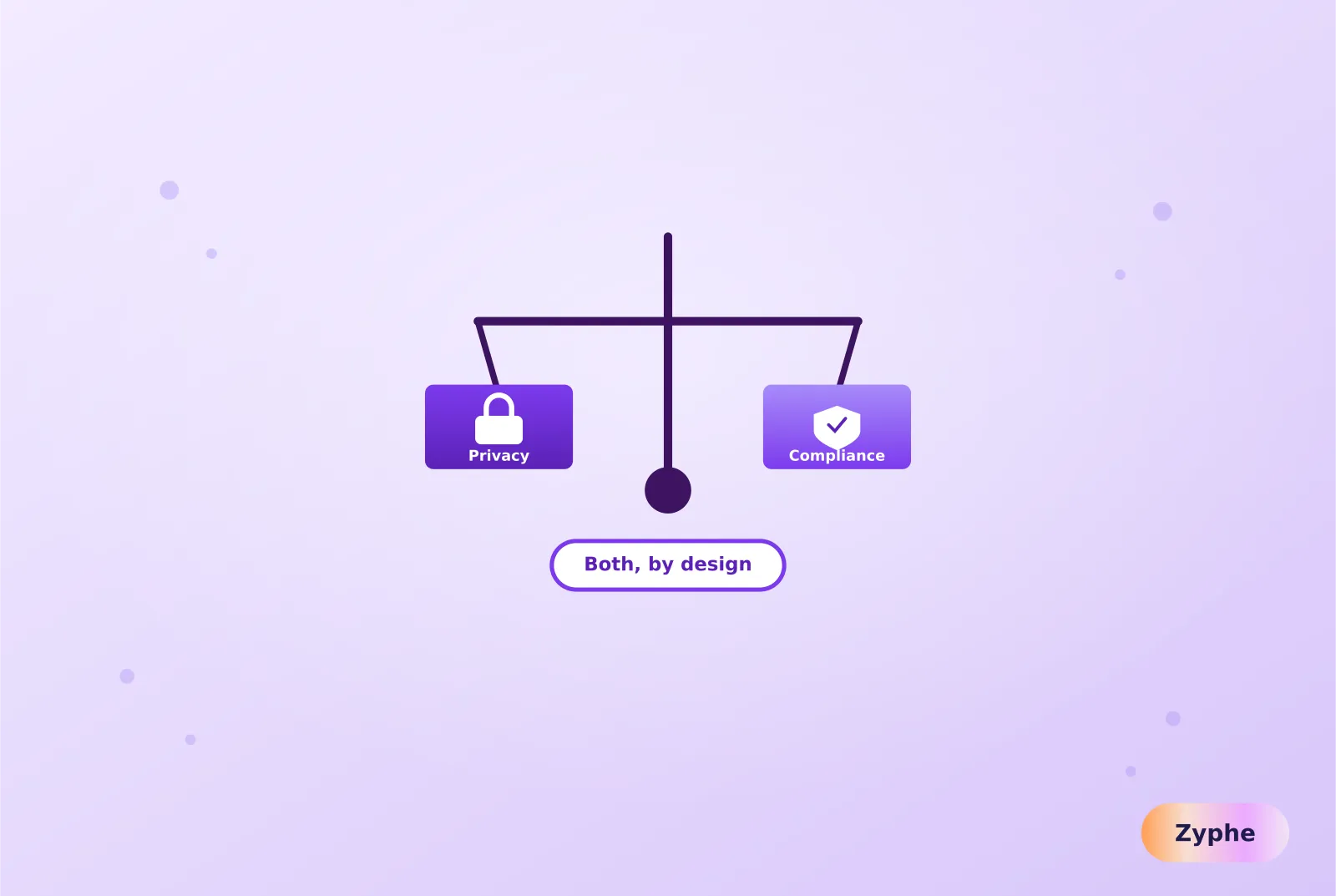
The privacy coin dilemma in 2026: where Zyphe draws the line between user privacy and regulator audit. The architecture and policy.
Table of contents
Key highlights
- Privacy-by-default coins like Monero, and shielded Zcash transfer patterns where the counterparty isn't recoverable, are not compatible with regulated VASP operations under FATF Recommendation 16, MiCA, or FinCEN.
- MiCA's Transfer of Funds Regulation introduced a zero-threshold rule: every CASP-to-CASP transfer requires originator and beneficiary identification, which privacy coins cannot satisfy when the counterparty is hidden.
- Across FATF, the EU, the US, Japan, South Korea, Australia, and the UK, regulators have converged on delisting privacy coins or applying EDD heavy enough to make high-volume listing impractical.
- Zyphe will not provide KYC to VASPs built around privacy-coin trading that breaks the Travel Rule, but will work with operators who list privacy coins alongside transparent assets under enhanced due diligence.
- Privacy belongs at the identity layer: zero-knowledge proofs, sharded user-controlled storage, and threshold-encrypted audit access deliver customer privacy without breaking compliance.
- Enforcement against Tornado Cash, Bittrex, and Binance shows regulators repeatedly use privacy-coin and mixer exposure as a foundational element of major AML penalties.
The privacy coin dilemma is the tension between a user's legitimate right to privacy and a regulated VASP's duty to share originator and beneficiary data on cross-VASP transfers. Technologies like Monero's ring signatures and Zcash's zk-SNARKs deliver privacy that exceeds fiat banking, but where the counterparty isn't recoverable from the transaction, FATF Recommendation 16, MiCA's TFR, and FinCEN's framework become mechanically impossible to meet.
Hero / opening
Privacy coin compliance is the topic where most KYC vendor blogs hedge. Both sides have a point. Both sides have customers. Both sides will share. We're not going to. After three years of watching this debate accumulate consequence, our position is concrete: privacy-by-default coins (Monero) and privacy-by-default-for-the-wrong-counterparties workflows (some Zcash shielded transfer patterns) are not compatible with regulated VASP operations under FATF Recommendation 16, MiCA, or FinCEN. This piece names the regulatory state, the operator-side reality, and where the line sits.
What is the privacy coin dilemma in regulated crypto compliance?
The dilemma in plain terms: privacy is a legitimate user right, and several technologies (Monero's ring signatures, Zcash's zk-SNARKs, mixers like Tornado Cash) deliver it in ways that meaningfully exceed what fiat banking offers. Regulated VASPs operating under FATF Recommendation 16 (the Travel Rule), MiCA's transfer-of-funds requirements, and FinCEN's BSA framework have to share originator and beneficiary identifying data on cross-VASP transfers above the threshold. Privacy coins where the counterparty isn't recoverable from the transaction make Recommendation 16 mechanically impossible.
This is where most vendor analyses end with "the industry needs more dialogue." That's the hedge we're not interested in. The dialogue has happened. The regulators have positioned. Operators have responded. The dilemma has resolved into a set of specific operational consequences worth naming.
For the broader regulatory backdrop, see our crypto KYC compliance breakdown and VASP KYC compliance: MiCA & FATF guide 2026.
How do FATF, MiCA, and major national regulators actually treat privacy coins?
Five regulatory positions worth tracking, with the operational implication for VASPs.
FATF. Recommendation 15 and the 2021 updated guidance on virtual assets flag anonymity-enhanced cryptocurrencies as elevated-risk by default. Member jurisdictions are expected to apply EDD or refuse the activity. The 2025 Recommendation 16 revision tightened expectations further by including fraud and proliferation financing in the Travel Rule scope.
We break down what these rules require in FATF Travel Rule compliance for crypto in 2026.
EU MiCA and the Transfer of Funds Regulation (TFR, 2023/1113). The TFR introduced a zero-threshold rule: every CASP-to-CASP transfer requires originator and beneficiary identification, with no value cut-off. Privacy coins where the counterparty isn't recoverable can't satisfy the TFR. EU exchanges have responded operationally by delisting Monero, Binance delisted Monero in February 2024 and Kraken delisted Monero from EU markets ahead of MiCA implementation.
For what MiCA demands of crypto firms, see MiCA KYC requirements in 2026.
United States, FinCEN, OFAC. OFAC sanctioned Tornado Cash in August 2022 and the developers were criminally charged. The signal: privacy-by-default protocols moving regulated value invite enforcement that affects users.
Japan, South Korea, Australia. All three jurisdictions have effectively banned privacy coins from regulated exchanges. Japan's FSA delisted privacy coins in 2018; South Korea's FSC and Australia's AUSTRAC followed.
United Kingdom, FCA. UK cryptoasset firms operating under FCA registration are expected to apply enhanced due diligence to privacy-coin transactions. Several major UK-facing exchanges have delisted privacy coins as the operational cost of EDD per transaction exceeded the trading volume.
The consolidated picture: in every major regulated jurisdiction, the regulatory expectation has converged on either delisting privacy coins or applying EDD that makes high-volume listing operationally impossible.
What's Zyphe's policy stance on privacy-coin VASPs?
Three positions, stated directly.
Position 1: We do not provide KYC services to VASPs whose primary business is privacy-coin trading where the privacy mechanism prevents Travel Rule compliance. Specifically: Monero-default exchanges, mixers, and protocols designed to break counterparty discovery. The architectural commitment we make to operators, that we run defensible KYC under a regulator-grade audit trail, is incompatible with onboarding VASPs whose business model is the regulator-facing problem.
Position 2: We do support VASPs that list privacy coins alongside transparent assets where the operator applies EDD and the regulatory regime permits it. Most major exchanges that still list Zcash run transparent-balance-only flows or enhanced due diligence on shielded-balance interactions. That's a defensible operating model under most regulatory regimes; we'll work with operators running it.
Position 3: We support privacy-preserving KYC architecture as a separate question from privacy-coin asset listing. Zero-knowledge proofs that prove identity attributes (over-18, sanctions-clear, EU-resident) without exposing the underlying document are how a regulated VASP can deliver customer privacy without breaking compliance. That's the architecture we ship in production, and it's a different question from which assets the VASP lists.
We explain the mechanics in how Zyphe uses zero-knowledge proofs in production KYC.
The synthesis: privacy is a legitimate value the regulated stack should optimise for at the identity layer. Privacy as an asset-level property that prevents Travel Rule compliance is a different question with a different answer.
For the architectural detail, see Decentralized KYC and Decentralized PII Storage.
How should a VASP handle privacy-coin listings under MiCA in 2026?
For an EU CASP under MiCA, three operational options, each with documented trade-offs.
- Delist all privacy coins. This is the path most major EU CASPs took ahead of MiCA's December 2024 effective date and the July 1, 2026 transition deadline. Operationally clean; reduces user choice; loses the slice of trading volume that came from privacy-coin listings.
- List Zcash with transparent-balance-only flows; refuse shielded-balance interactions. Several exchanges run this pattern. The Travel Rule applies to transparent transactions; shielded transfers are blocked at the operator's compliance layer. Operationally workable; user experience is degraded for Zcash holders.
- Apply enhanced due diligence per privacy-coin transaction. Every privacy-coin transaction triggers full EDD: source-of-funds documentation, behavioural-pattern analysis, manual review. Operationally expensive; defensible under most regulatory regimes if the documentation is rigorous; commercially marginal at most volumes.
The operator-side reality: most CASPs that run option 3 eventually move to option 1 because the EDD overhead per transaction exceeds the revenue. That's an empirical observation, not a policy argument.
For the regulatory backdrop, see crypto KYC compliance in 2026 and the EU's MiCA framework.
How is privacy preserved correctly at the identity layer?
The architectural answer to the privacy-coin debate isn't to defend privacy at the asset layer; it's to deliver it at the identity layer where the technology is mature and the regulator's expectations are aligned.
Three primitives that ship in production today:
- Sharded user-controlled storage. Customer documents are fragmented across decentralised nodes the vendor cannot reconstruct without user consent. The customer holds the encryption key. The verification still happens; the breach surface goes away.
This is why we argue centralised PII storage is your biggest liability in the identity breach epidemic of 2026.
- Zero-knowledge proofs of identity attributes. "This customer is over 18" or "this customer is sanctions-clear" are predicates the contract can verify without the underlying document. The PII never reaches the chain or the operator's data plane.
See how this works end to end in decentralised KYC explained.
- Threshold-encrypted audit access. Regulators verify the check ran, the policy version, the timestamps, and the decision logic without ever seeing the underlying document. Audit defensibility plus customer privacy in the same architecture.
For the deeper specs, see is KYC safe in 2026 and the identity breach epidemic 2026 analysis.
What enforcement actions shaped the privacy-coin landscape?
Three cases that defined the regulatory direction:
- Tornado Cash, OFAC sanctions designation (August 2022). OFAC sanctioned the protocol and the developers were criminally charged. The first time a fully-decentralised privacy protocol was treated as a sanctioned entity in its own right.
- Bittrex, USD 53 million OFAC + FinCEN penalty (October 2022, bankruptcy 2023). Per Treasury, Bittrex failed to address risks associated with anonymity-enhanced cryptocurrencies in its monitoring programme. Counterparties on darknet markets and ransomware moved through the platform.
- Binance, USD 4.3 billion DOJ / FinCEN / OFAC settlement (November 2023). Combined enforcement that included AML failures on transactions involving privacy-coin and mixer-adjacent counterparties.
The pattern: regulators have repeatedly used privacy-coin and mixer exposure as a foundational element of major AML enforcement actions. Operators that listed privacy coins without commensurate EDD inherited the regulatory exposure.
What should an operator decide in the next 90 days?
Five concrete moves for any VASP currently listing or considering privacy-coin assets:
- Document your current privacy-coin exposure. Trading volume, customer concentration, jurisdictional split.
- Map your obligations against the most restrictive regulator you face. EU MiCA TFR, FCA, FinCEN, MAS, pick the strictest applicable.
If you operate an exchange, our KYC for crypto exchanges onboarding guide covers the compliant flow.
- Decide between delisting, transparent-only listing, or full EDD. Run the unit economics. Most operators converge on delisting for Monero and transparent-only for Zcash.
- Audit your transaction-monitoring stack for anonymity-enhanced asset exposure. Even after delisting, indirect exposure persists through cross-VASP transfers.
For what the rules actually require here, read AML transaction monitoring in 2026.
- Tighten your customer-segmentation model. Customers with high privacy-coin activity are a specific risk tier; the risk assessment for crypto compliance should reflect that.
For the broader operator playbook, see building a robust AML strategy for crypto exchanges.
Where does the privacy coin dilemma actually land?
The privacy-coin dilemma is a dilemma for vendor blogs that need both sides to keep paying. Operationally, the regulatory expectations have converged. Privacy-by-default coins are incompatible with Travel Rule compliance in the major regulated jurisdictions. Privacy as an identity-layer property is fully compatible with regulated operations and is what every operator should be building towards.
If the architectural conversation belongs in your roadmap ,privacy delivered at the identity layer, asset listings shaped by your risk appetite, book a 30-minute walkthrough and we'll show how the two questions resolve separately.
When is full EDD on privacy coins not the right call?
Applying enhanced due diligence per privacy-coin transaction sounds like the responsible middle path, but it rarely holds up commercially. Every transaction triggers source-of-funds documentation, behavioural-pattern analysis, and manual review, and the overhead per transaction often exceeds the revenue the listing generates. Most CASPs that start with full EDD eventually move to delisting because the unit economics stop working. That's an empirical observation, not a policy argument.
Transparent-only Zcash listing is workable but degrades the user experience for Zcash holders, and delisting reduces customer choice and loses the trading volume privacy coins brought in. None of the three options is clean. The right call depends on your jurisdiction, your volume, and how much manual review your compliance team can sustain. Map your obligations against the strictest regulator you face before you decide.
Related resources
- Compliance: Crypto KYC compliance in 2026
- Architecture: Is KYC safe in 2026? After the IDmerit breach
- VASP framework: VASP KYC compliance: MiCA & FATF guide 2026
 Edoardo Mustarelli(Sales Development Representative)Edoardo Mustarelli, fintech/Web3 strategist at Zyphe, driving sales growth and partnerships with global expertise across technology, finance, and strategy.