Onfido is now Entrust IDV. See what Onfido verification is, the best Onfido alternatives in 2026, and how Zyphe's decentralized, privacy-first model compares.
Table of contents
Key highlights
- Onfido verification is AI-powered document and biometric identity verification. Since Entrust completed its acquisition in April 2024, it is offered as Entrust IDV inside Entrust's wider identity portfolio.
- Most teams searching for Onfido alternatives are weighing the move to an enterprise security suite, or want a different data model, pricing, or reusable credentials.
- The credible Onfido alternatives in 2026 are Veriff, Sumsub, Persona, Jumio, and the privacy-first option, Zyphe.
- The structural difference is storage: Onfido and most rivals hold verified data in their own cloud, while Zyphe shards it across decentralised nodes with a customer-held key.
- Pricing model matters too. Onfido and Entrust are sales-led with annual contracts, while Zyphe is usage-based with no minimum and integrates in around 15 minutes.
- Onfido remains a strong choice for enterprises standardising on the Entrust stack, so this guide is honest about when to stay.
Onfido verification is AI-powered identity verification, now offered as Entrust IDV after Entrust acquired Onfido in 2024, that checks a government-issued ID and a biometric selfie to confirm a person is who they claim to be. Teams looking for Onfido alternatives usually want decentralised data storage, reusable credentials, or usage-based pricing rather than an enterprise contract.
TL;DR
Onfido verification is AI-powered document and biometric identity verification, now delivered as Entrust IDV after Entrust completed its acquisition of Onfido in April 2024. It is strong, well-audited technology, and most teams searching for Onfido alternatives are not unhappy with accuracy. They are deciding whether they want an enterprise security suite, or a different data model, pricing, or reusable credentials.
The credible Onfido alternatives in 2026 are Veriff, Sumsub, Persona, Jumio, and Zyphe as the privacy-first option. They differ most on where data is stored, whether reusable credentials are standard, and whether pricing is usage-based or a sales-led annual contract. This guide explains exactly what Onfido verification is, profiles each alternative fairly, compares them, and is honest about when Onfido remains the right call.
11 min read. Last updated 8 June 2026.
What is Onfido verification?
Onfido verification is an identity verification process that confirms a person is who they claim to be by checking a government-issued identity document and matching it to a live biometric selfie. The system uses AI to authenticate the document, detect tampering and forgery, and run a liveness check to confirm a real person is present rather than a photo or deepfake. It is used for customer onboarding, fraud prevention, and KYC compliance across regulated industries.
Onfido built its reputation on AI-led document and biometric verification and on widely cited fraud research, including data on rising deepfake and forged-identity attempts. If you have seen a sign-up flow that asks you to photograph your passport and take a selfie, that is the category Onfido helped define. For how it sits against the wider market, see our identity verification software comparison.
Is Onfido still Onfido after the Entrust acquisition?
Yes, the technology continues, but the brand and context changed. Entrust completed its acquisition of Onfido in April 2024, in a deal reported at around $650 million, and Onfido's identity verification now sits inside Entrust's broader identity-centric security portfolio, increasingly under the Entrust IDV name. Onfido had more than 1,200 customers and significant revenue at acquisition, so the capability did not go anywhere, it became part of a larger enterprise security vendor.
For buyers, that has a practical effect. You are now evaluating a component of an enterprise suite rather than a standalone startup product, which is a strength if you want issuance, access management, and verification from one vendor, and a consideration if you wanted a focused, independent IDV API. That shift is part of why some teams now look at Onfido alternatives, which the next section addresses fairly.
Why do teams look for Onfido alternatives?
There are a few honest reasons, none of which is that Onfido verification does not work.
The first is the enterprise model: Onfido and Entrust are sales-led, with annual contracts that buyers commonly report starting in the tens of thousands, and integration that runs as an enterprise project. Teams wanting usage-based pricing and a fast API look elsewhere. The second is data architecture: like most of the category, Onfido stores verified data in its own cloud, which concentrates breach and GDPR exposure, as we discuss in why your KYC vendor is your biggest data breach risk. The third is reusable credentials: teams increasingly want a verified identity that can be re-presented without re-uploading documents, which is not Onfido's core model. The fourth is simply suite fit: if you are not standardising on Entrust, a focused alternative may suit you better.
What are the best Onfido alternatives in 2026?
Five alternatives deserve a real look, each with a genuine strength and an honest trade-off.
Zyphe is the privacy-first alternative, sharding identity data across more than 60,000 decentralised nodes with a customer-held key, offering reusable credentials as standard, and pricing on usage with no minimum. The trade-off is that it is the architecture-led newcomer rather than an incumbent brand.
Veriff competes on speed, with a roughly six-second median decision, around 98 percent automation, and a video-based verification flow. Best for consumer onboarding where speed and pass rates matter most.
Sumsub is the all-in-one suite covering verification, KYC and KYB, AML screening, and monitoring, especially strong in crypto. Best when you want onboarding and monitoring from one vendor.
Persona offers low-code, configurable verification workflows. Best for teams that want to build and iterate flows without engineering.
Jumio is the long-established enterprise incumbent with broad coverage and mature certifications. Best for large regulated institutions that want an audited, named vendor.
How do the Onfido alternatives compare?
The table scores the alternatives on the criteria that actually drive the decision. Every option here verifies identity capably.
| Platform | Data storage | Reusable credentials | Pricing model | Integration |
|---|---|---|---|---|
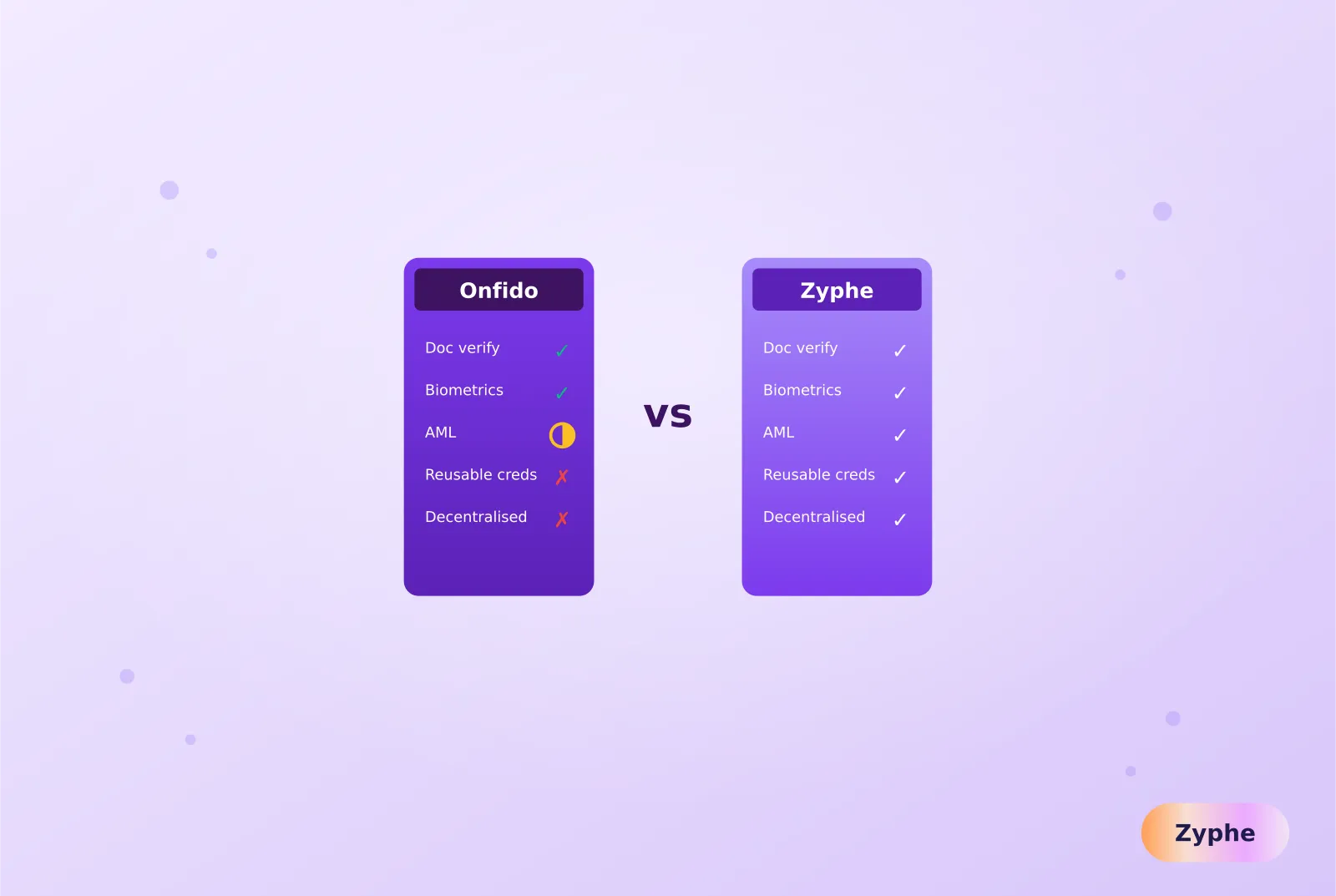
| Onfido (Entrust IDV) | Centralised vendor cloud | Limited | Sales-led, annual contract | Weeks (enterprise) |
| Zyphe | Decentralised, customer-held key | Yes, standard | Usage-based, no minimum | Around 15 minutes |
| Veriff | Centralised vendor cloud | No | Per-verification | Days |
| Sumsub | Centralised vendor cloud | Yes, Enterprise tier | Per-verification, $149/mo min | Days |
| Persona | Centralised vendor cloud | Limited | Usage plus enterprise tiers | Days |
| Jumio | Centralised vendor cloud | No | Sales-led, annual contract | Weeks (enterprise) |
The takeaway: verification quality is broadly a solved problem across these vendors, so the real choice is data architecture, reuse, and the pricing and contract model.
What makes Zyphe different from Onfido and Entrust?
The core difference is where your customers' data lives and who controls it. Onfido, like the rest of the field, stores verified identities in its own cloud. Zyphe distributes each record across more than 60,000 decentralised nodes using a 29-of-100 threshold scheme, and the customer holds the encryption key, so Zyphe has no master key and a breach yields fragments, not identities. This is the foundation of decentralised KYC.
Reusable credentials are standard rather than an afterthought, so a verified user can re-present their identity without re-uploading documents, reducing onboarding drop-off. Verification uses NFC chip reads from passports and ID cards and a two-step liveness check with no user image upload, data residency is enforced per region, and the KYC software integrates in around 15 minutes on usage-based pricing with no minimum. The honest trade-off: if your organisation is standardising on Entrust for issuance and access management, keeping verification in that stack has real integration value that a focused alternative does not.
How do you switch from Onfido?
Moving off an enterprise contract takes planning, but the technical switch to an API-first platform is straightforward. Run the new provider in parallel on a traffic slice while Onfido stays live, and compare completion and fraud outcomes on real users. Map your verification steps and risk rules to the new flow, and confirm document coverage for your markets. Integrate the API, which Zyphe targets at around 15 minutes, and wire decisions into onboarding. Cut over progressively by segment or geography, then decommission the old flow once the new one clears your metrics.
The contract is usually the gating item, not the technology, so time your migration to your renewal window. Because Zyphe is usage-based with no minimum, you are not committing to volume you have not validated.
When is Onfido still the right choice?
Switching is not always right. Stay with Onfido, now Entrust IDV, if you are standardising on the Entrust portfolio, because having verification, issuance, and access management under one enterprise vendor is genuinely valuable and re-integrating across tools is real work.
Stay, too, if your procurement specifically requires a large, long-established, heavily audited vendor with enterprise support and references, which Onfido and Entrust provide. And if your data-storage model and pricing already fit, the case for switching is weak. Move when your constraint is decentralised storage, standard reusable credentials, usage-based pricing, or a faster integration than an enterprise rollout allows. If that is you, book a demo or read how it works.
The bottom line
Onfido verification is solid, well-audited document and biometric identity verification, now part of Entrust as Entrust IDV. The question is not whether it works, it is whether an enterprise suite on an annual contract, with data in a vendor cloud, is the right shape for you. If you are standardising on Entrust, it likely is.
If your constraint is decentralised storage, standard reusable credentials, usage-based pricing, or a faster integration, Zyphe is the privacy-first Onfido alternative worth a parallel pilot. Either way, choose on architecture and fit, not on accuracy, which the leading options have all solved.
Book a demo, see how it works, or compare pricing.
Related resources
- Identity verification software comparison 2026
- Why your KYC vendor is your biggest data breach risk
- Decentralised KYC
- KYC software
- Sumsub alternatives
- Pricing
Cited sources
- Entrust, completion of Onfido acquisition, April 2024: entrust.com
- TechCrunch, Entrust to acquire Onfido (reported terms), February 2024: techcrunch.com
- EU GDPR information portal: gdpr-info.eu
- FATF Recommendations: fatf-gafi.org
 Michelangelo Frigo(Co-Founder at Zyphe)Michelangelo Frigo is a privacy and identity infrastructure expert and co-founder of Zyphe.